

Quick fix — handling problems
From the team's Quick Fix chart. One change at a time — and remember the ½-turn rule on springs.
Setup targets
Gear chart + calculator
Ratio = ring ÷ pinion, × transmission multiplier (2nd ×2.000 · 3rd ×1.572 · 4th ×1.291 · 5th ×1.115). Gear to run 9,250–9,500 rpm.
Legends car — exploded view
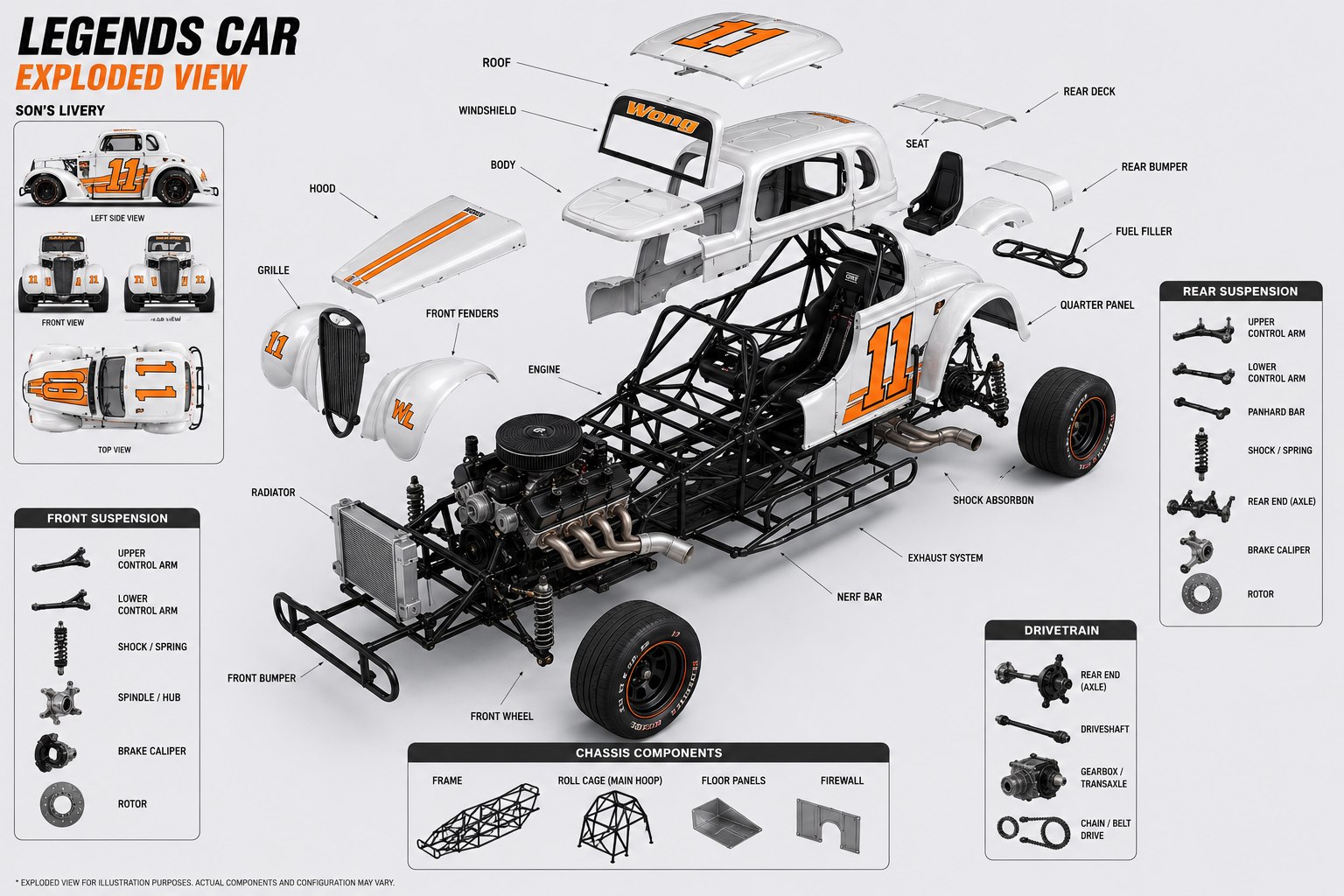
Tap a part below the diagram to see what it does and how the team looks after it.
Team library — shock baselines, inspection gauges, rulebook essentials
Starting points for the adjustable AFCO Legends shocks, by surface. Each corner shows compression / rebound settings. Two published starting combinations exist (A and B) — pick one, run it, and adjust one corner at a time from there, judged by the stopwatch and driver feedback.
Summarized from the baseline recommendations published by U.S. Legend Cars International and AFCO for INEX-approved AFCO Legends shocks. Confirm current guidance with USLCI/AFCO.
Racing calendar
Loading schedule…
Density altitude — what the engine is breathing
Elevation is the track's height above sea level; baro is the altimeter setting from any nearby weather report (airport METAR works);
dew point sharpens the answer on humid Georgia days.
Using it: log the density altitude alongside your session notes. When today's DA is much higher than the day your jetting was right, the air is thinner — the engine runs richer, so you typically lean the jetting and expect less power. Much lower DA = denser air = richen up and expect more grunt. Move one step at a time and confirm with plug readings and lap times — the calculator informs the change, the stopwatch confirms it.
Using it: log the density altitude alongside your session notes. When today's DA is much higher than the day your jetting was right, the air is thinner — the engine runs richer, so you typically lean the jetting and expect less power. Much lower DA = denser air = richen up and expect more grunt. Move one step at a time and confirm with plug readings and lap times — the calculator informs the change, the stopwatch confirms it.
Flags
Driver reminders
Terminology
Pitwall
Pitwall (phone) logs it at the car — checklists, laps, photos, walkarounds. Rennium HQ (big screen) analyzes it — dashboards, comparisons, charts, exports.